
1Who handles mosquitoes in your county
California has more than 60 mosquito and vector control districts, and in this region they are the first call for a mosquito problem. They are public agencies, and several, including the Monterey and San Mateo districts, are funded through property taxes and assessments. The services below are the districts' own, described from their websites; they are not services of 101 Exterminators. If your address is not covered, the agency lookup by ZIP code on westnile.ca.gov will find the right office.
- Northern Monterey County: the Monterey County Mosquito Abatement District serves Salinas, Marina, Seaside, Sand City, Del Rey Oaks, Monterey and unincorporated northern Monterey County. Residents can ask the district for an inspection or mosquitofish and report a possible source such as a pool, hot tub, old tires, an open septic tank, a plumbing leak or a backyard pond, anonymously if they wish. (831) 422-6438.
- Santa Cruz County: Santa Cruz County Mosquito and Vector Control covers the whole county and lists free services for residents, including mosquito inspections, mosquitofish for ponds, troughs, water features and unused pools, and dead bird pickup for West Nile virus testing.
- San Mateo County: the San Mateo County Mosquito and Vector Control District covers the entire county, at no additional charge to residents. Requests go through its online form or (650) 344-8592, and it delivers mosquitofish to any county resident.
- Alameda County: the Alameda County Mosquito Abatement District handles mosquitoes, responding to complaints, inspecting and treating sources, and delivering mosquitofish free of charge. Its About page names the city of Albany as outside its service. (510) 783-7744. The county's separate Vector Control Services District does not handle mosquitoes.
- San Francisco: the Department of Public Health's Environmental Health branch treats mosquitoes as vermin that property owners must keep their buildings free of, and may set traps on a property to find a source.
- San Benito County: a 2019 county health advisory directs residents with a significant mosquito problem to the Agricultural Commissioner or Environmental Health.
- Santa Clara County and southern Monterey County: use the westnile.ca.gov ZIP lookup to reach the agency for your address.
Sources: Pest Notes: Mosquitoes · West Nile Virus Activity in California · Area of Service · Contact Us · Services Offered · Request Service · About Us · Mosquitoes · Keeping Your Building Free of Vermin · West Nile Virus Health Advisory (2019)
2West Nile virus in these counties in 2026
West Nile virus is the most common and serious vector-borne disease in California, and Culex mosquitoes are the main species that spread it. CDPH says those mosquitoes usually bite in the morning and evening, and that mosquitoes are active year-round in California. As of October 23, 2026, CDPH reported West Nile virus activity at a five-year high statewide, with 452 human cases and 29 deaths.
Locally, the picture is concentrated in the South and East Bay. CDPH's 2026 county table lists 2 human cases, 120 positive dead birds and 5 positive mosquito samples in Santa Clara County; 39 positive dead birds and 10 positive mosquito samples in Alameda County, where the district reports positives in Newark, Union City, Fremont, Livermore, Pleasanton and Oakland; and 10 positive dead birds in San Mateo County, from Atherton, East Palo Alto and Menlo Park. The San Mateo district had tested 5,474 mosquitoes without a positive. Monterey, San Benito, San Francisco and Santa Cruz counties had no 2026 detections listed. In 2025, CDPH recorded one human case in Monterey County.
CDPH says dead birds are often the first sign that West Nile virus is active in an area. Report a dead crow, jay, magpie, raven, sparrow, finch or hawk at westnile.ca.gov/report or 1-877-968-2473. CDPH says it is extremely unlikely that a person or pet would catch the virus from a dead bird; use disposable gloves or an inside-out plastic bag if you move one.
Sources: West Nile Virus Activity in California · West Nile Virus FAQs and Basics · 2025 West Nile Virus Activity by County · West Nile Virus Activity · Current West Nile Virus Information for San Mateo County · Report a Dead Bird
3The day-biting mosquito now found around the Bay
If you are getting bitten in the middle of the day, report it. Aedes aegypti is an invasive mosquito that, according to CDPH, lives only near people, lays eggs in any small container that holds water, indoors or out, and bites during the day. The San Mateo district describes it as small, about a quarter inch, black and white, and an aggressive daytime biter that needs only about a teaspoon of water to develop.
CDPH's list of detections, updated May 1, 2026, shows Aedes aegypti present in Livermore and San Jose. District reports since then go further. The Alameda County district has found it in Pleasanton, Dublin, Livermore, Fremont, Castro Valley and Hayward since 2024, and the San Mateo County district confirmed it in Redwood City, North Fair Oaks and San Carlos between July and October 2026. Santa Cruz County's first detection was in Watsonville in October 2022.
The San Mateo district calls the current risk of this mosquito spreading disease in the county very low, and CDPH says dengue is the only virus these mosquitoes have spread in California, very rarely. Districts ask residents to keep reporting daytime bites so staff can follow up and find the containers it is breeding in.
Sources: Aedes aegypti and Aedes albopictus Mosquitoes · Aedes Detections by County and City · Invasive Aedes aegypti in Alameda County · Aedes aegypti Detections · Invasive Aedes aegypti Mosquitoes Found in San Carlos · Invasive Aedes
4Where mosquitoes breed around a house
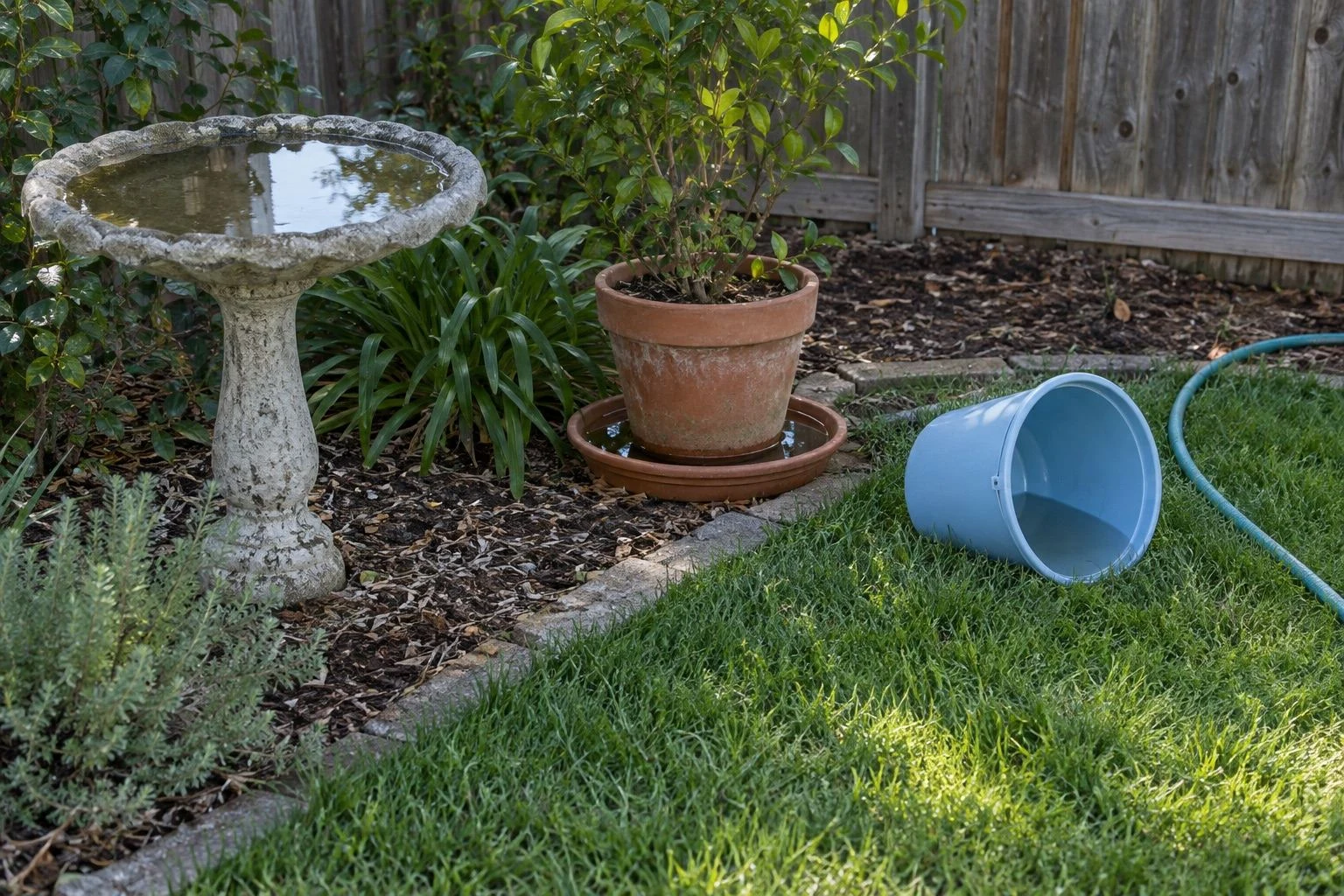
Every mosquito starts in water. UC IPM says the full cycle from egg to adult can take a week or less in summer, and that even a bottle cap of standing water can support larvae. Some eggs are laid on the sides of plant saucers, jars and cans and do not hatch until water returns, which can be months or years later, so a container that dried out is not necessarily clean.
The larvae, often called wigglers, are usually black or brown and live in stagnant or nearly still water. Look for them in the places UC IPM and the districts name most often:
- Plant saucers, buckets, toys, pet dishes, watering cans and tarps that collect sprinkler or rain water.
- Bird baths and fountains. UC IPM advises changing bird bath water at least once a week.
- Rain barrels, which UC IPM says should be screened or sealed at every opening.
- Roof gutters that hold water, plus yard drains and leaky plumbing.
- Swimming pools and hot tubs that are not maintained. The Alameda County district says a single neglected pool can produce millions of mosquitoes in a month.
- Ornamental ponds and water features, especially with heavy plant growth.
- Tree holes, home to the western treehole mosquito, which the Alameda County district calls an aggressive daytime biter and the main carrier of dog heartworm in that county.
UC IPM notes that some adult mosquitoes can fly several miles from where they developed. Clearing water on your own lot is still the most useful thing you can do, but it may not remove every mosquito; a district can look at sources beyond your fence.
Sources: Pest Notes: Mosquitoes · Backyard Checklist · Swimming Pools · Local Mosquitoes
5What does not work
UC IPM has assessed many popular mosquito products and devices. These are the ones it says do not deliver.
- Bug zappers. UC IPM calls them counterproductive, because many of the insects they kill are ones that prey on mosquitoes.
- Ultrasonic emitters, electronic repellers, scented wristbands, the so-called mosquito plant, incense coils, vitamin B1, and brewer's yeast with garlic. UC IPM lists all of them as ineffective.
- Outdoor sprays and foggers on their own. UC IPM says they can briefly reduce adult mosquitoes but have no lasting effect, and it does not recommend systems that release small amounts of insecticide continuously.
- Counting on bats. Santa Cruz County Mosquito and Vector Control notes that studies of wild bats found mosquitoes make up less than one percent of their diet.
Sources: Pest Notes: Mosquitoes · Frequently Asked Questions
6Ponds, troughs and mosquitofish
A pond or trough you want to keep does not have to be a mosquito source. UC IPM says mosquitofish (Gambusia affinis) can be an important control in man-made water that does not connect to natural water, and that most vector control districts supply them. Monterey, Santa Cruz, San Mateo and Alameda county districts all offer mosquitofish to residents. Thinning excess pond vegetation helps too.
There is one firm rule. UC IPM says mosquitofish are not native to California and must never be released into streams, ponds or lakes; doing so is illegal. Keep them in the pond, trough or unused pool the district placed them in.
Sources: Pest Notes: Mosquitoes · Contact Us · Mosquito Fish · Request Mosquitofish · Backyard Checklist
7West Nile virus symptoms and when to get care
CDPH says about 4 in 5 people infected with West Nile virus have no symptoms. About 1 in 5 develop fever, headache, body aches, nausea, vomiting and sometimes a rash, usually 3 to 14 days after the bite. About 1 in 150 become very sick, with the virus affecting the brain or nervous system. People over 60 are at greatest risk, as are people with conditions such as cancer, diabetes, hypertension or kidney disease and organ transplant recipients. There is no vaccine.
CDPH advises seeking medical care immediately for signs of severe West Nile virus, such as an unusually severe headache or confusion. For any symptoms after mosquito bites, talk to a doctor or other healthcare provider.
Sources: West Nile Virus FAQs and Basics