
101 Exterminators
Service Areas
Pests
Articles
Guides
Resources

Bed Bugs on the Central Coast: Signs and Prevention

Bed bugs are flat, reddish-brown insects about the size of an apple seed. They hide within about 8 feet of where people sleep, and UC IPM finds roughly 85% of infestations in or near the bed itself. They spread by hitchhiking on luggage, clothing, and used furniture, not by poor housekeeping. Store-bought foggers rarely work, because the fog cannot reach bugs deep in seams and cracks, so the EPA calls for a combined plan of laundering, encasements, targeted treatment, and follow-up.

By 101 Exterminators Inc. · SPCB Lic. #9119Last updated August 29, 2026
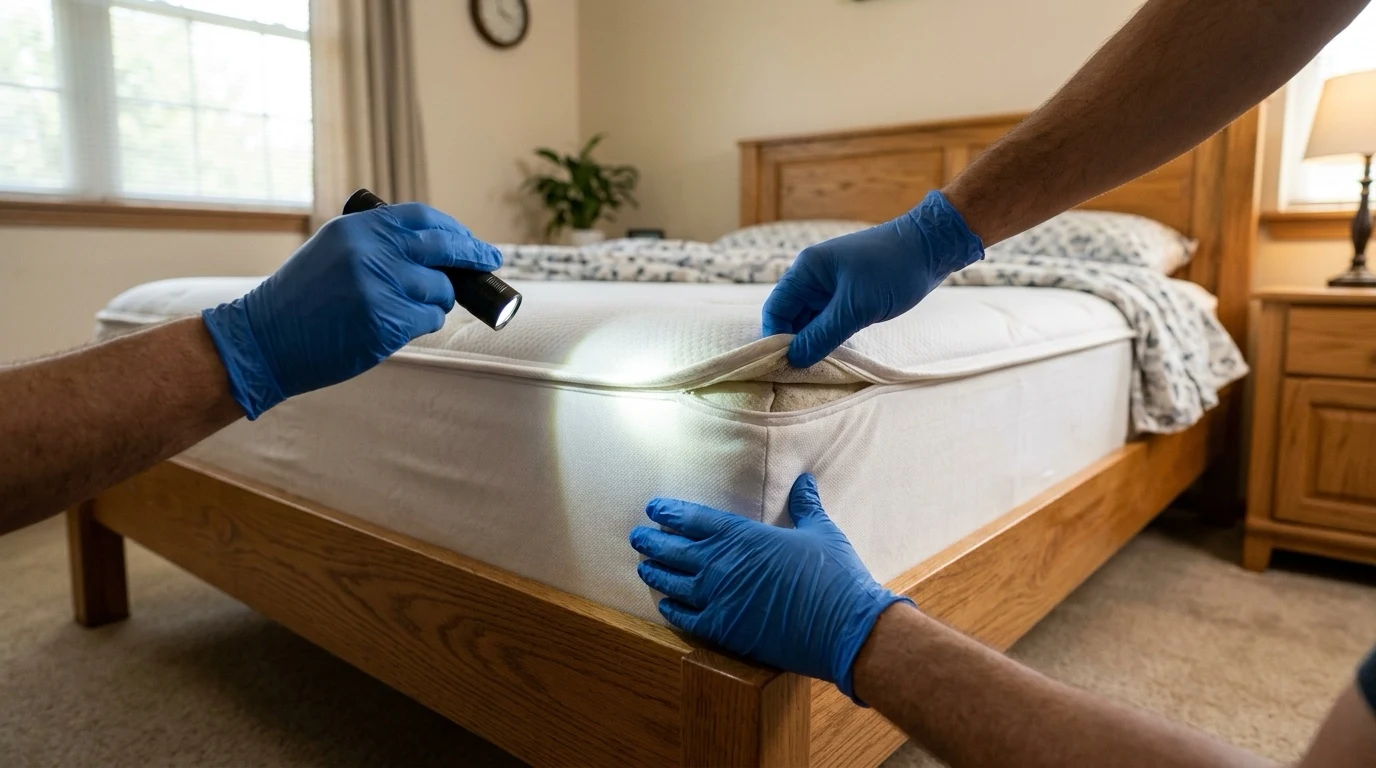
Two technicians in blue gloves work along the piped seam of a stripped mattress, one lifting the cover while the other rakes a flashlight beam across the fabric.
Most bed bug evidence sits within a few feet of the bed: mattress piping, the inside of the box spring, and the joints of the frame. Illustrative photo.

1What bed bugs look like at every life stage

One species accounts for the problem in local homes: Cimex lectularius, the common bed bug. An adult is flat, oval, and wingless, reddish-brown, and about a fifth of an inch long, which is close to the size of an apple seed. Young bed bugs, called nymphs, run from a twentieth to a fifth of an inch and look paler, closer to yellowish white. Eggs are about a millimeter long and pale, glued into seams and joints. Shed skins look like hollow, see-through copies of the bug. All of these are visible without a magnifier. The EPA is direct about it: the problem is not that bed bugs are invisible, it is that they hide well.

You will almost always find evidence before you find a live insect. Bed bugs shelter in gaps as thin as a credit card, so a glance at a made bed shows nothing at all. The clues that hold up are physical. Dark fecal spots bleed into fabric the way a marker does. Crushed bugs leave rusty smears on sheets. Pale eggs and empty shed skins pack into mattress piping and frame joints. In a heavy infestation, UC IPM notes a sweet, musty odor in the room.

2How bed bugs get into homes on the Central Coast

Bed bugs do not fly, and they do not wander in from the yard. They arrive on something that comes through the door. UC IPM and the CDC both point to the same two routes: travel and secondhand furniture. Shared and multi-unit housing then moves them between homes once they are established in a building.

On this coast, two patterns shape the calls we take. Monterey and Santa Cruz counties run on lodging, with hotels, inns, and short-term vacation rentals turning guests over fast, and high occupant turnover is a documented risk factor. On our service visits the first infested room is often the guest bedroom, where a suitcase sat for a week after a trip. Inland, housing type matters more than tourism. Salinas and Hollister carry a lot of older apartment stock with shared walls, and student and seasonal housing moves used mattresses and couches from one household to the next. Those are the two doors bed bugs use here, and they are the two worth guarding.

Timing follows travel, not weather. Bed bugs live indoors year round, so they have no swarm season the way termites and ants do. A National Pest Management Association survey of pest professionals reports that more than half see their heaviest bed bug volume in summer. The association attributes that to travel. It is industry survey data rather than peer-reviewed work, so read it as a pattern rather than a hard figure, and it matches what a lodging economy looks like here in July.

  • Travel. Luggage, backpacks, and clothing carry bed bugs home from hotels, motels, vacation rentals, buses, and trains.
  • Used furniture. UC IPM flags secondhand mattresses, box springs, and upholstered furniture as a known high-risk source. The curbside couch is the classic case.
  • Shared walls. In apartments, condos, motels, dorms, and shelters, bed bugs move between connected units on their own, which is why EPA guidance for landlords covers the units on both sides, above, and below.

Note: Bed bugs are not a housekeeping problem. The EPA states they are drawn to warmth, blood, and carbon dioxide, not to dirt, and clean homes are as susceptible as messy ones. Clutter does not attract them either, though it adds hiding places and makes an inspection harder.

3What bites tell you, and what they do not

Bites are the weakest clue you have. The CDC reports that reactions vary widely from person to person: no physical sign at all, small bite marks, or in rare cases a serious allergic reaction. Marks can take anywhere from 1 to 14 days to appear. Two people can share a bed and only one of them shows anything. That delay also breaks the link between the marks and the night they happened, so bites cannot tell you which room or which trip started it.

The health picture is narrower than most people expect. The EPA states there are no documented cases or studies showing that bed bugs transmit disease between humans, and the CDC says they are not known to spread diseases to people. The real cost is itching, irritation, and lost sleep, and scratching can lead to a secondary skin infection. Treat bites as a prompt to inspect, then confirm with physical evidence before anyone treats anything.

4Where to look during a self-inspection

Start at the bed and work outward. UC IPM finds roughly 85% of infestations in or near the bed itself, meaning the mattress, box spring, frame, and headboard. The CDC notes that bed bugs tend to stay within about 8 feet of where people sleep, even though they can travel more than 100 feet in a night. Work in strong light and hold a flashlight at a low angle so the beam rakes across the fabric and throws shadows into the seams.

  1. 1

    Strip the mattress and box spring

    Pull off all bedding and bag it for laundering before you move it through the house. Run the flashlight along the piping, the seams, the tufts, and the tag. Stand the mattress on its side and check the underside. On the box spring, lift the dust cover at each corner and look inside the wooden frame, which is where evidence often sits. You are looking for live bugs, pale eggs about a millimeter long, hollow shed skins, and dark fecal spotting.

  2. 2

    Take apart the bed frame and headboard

    Bed bugs favor joints, bolt holes, and cracks in wood. Check the frame rails, the slats, and every screw hole. If the headboard mounts to the wall, lift it off and inspect the back face and the wall behind it. Any gap as thin as a credit card is wide enough to hold a colony of them.

  3. 3

    Work outward through the nearby furniture

    Pull the drawers all the way out of nightstands and dressers, then inspect the drawer joints, the runners, and the inside of the empty cabinet. Check upholstered chairs along the seams, the folds, and the underside of the frame. Bed bugs shelter in furniture as readily as in bedding, and an armchair beside the bed is prime ground.

  4. 4

    Check the edges of the room

    Look at baseboards, the gap where carpet meets the wall, curtain hems, outlet and switch plates, loose wallpaper, and the joint where the wall meets the ceiling. Evidence this far from the bed usually means the infestation has been building for a while rather than starting last week.

Warning: Do not treat what you find with household chemicals. The EPA warns that rubbing alcohol, kerosene, and gasoline can harm you and your family and can easily ignite. Photograph the evidence and have it identified before anything is sprayed.

5Why foggers, sprays, and home remedies fall short

A pesticide has to physically touch a bed bug to kill it, and that one fact explains most do-it-yourself failure. A total-release fogger puts mist into open air. The bugs are inside seams, joints, and wall voids the mist never reaches. The EPA states that foggers should not be used as the sole source of bed bug control, and it warns separately that foggers used improperly carry a fire and explosion risk from their flammable propellants.

Resistance is the second problem. Resistance to common pesticides is now widespread in bed bug populations, so a product can thin a group without ending it. A partial knockdown is worse than none, because disturbing an infestation pushes bed bugs to move. In a peer-reviewed apartment study, marked bed bugs dispersed into neighboring apartments in five of the six units studied, and some were recaptured about 12 meters from the point where they were released. Between 39% and 67% of the marked bugs traveled at least 2.5 meters from the sleeping area within about two weeks.

Three other common fixes fail for reasons of their own.

  • Leaving a light on at night. Bed bugs prefer the dark, but the EPA notes they will still feed with the lights on.
  • Home freezing. UC IPM puts the lethal threshold at 32°F or lower held for several days, and the EPA cautions that do-it-yourself freezing may not be a reliable method because home freezers rarely hold that.
  • Throwing out the mattress first. The EPA advises against discarding furniture when the bed bugs can be safely eliminated from it, and a discarded mattress does nothing about the bugs already in the frame and baseboards.

6What to do when you share a wall

In an apartment, condo, duplex, or motel, a bed bug problem is rarely confined to one unit. The research on apartment buildings shows bed bugs migrate into neighboring units on their own, without anyone carrying them. That is why EPA guidance for landlords calls for evaluating, and where needed treating, the units on both sides, above, and below the one with the report. A single-unit fix in a shared building tends not to hold.

Moving out of the bedroom is the common instinct and the wrong call. Relocating to the couch, a spare room, or another household spreads the problem to a second location instead of ending it in the first. The published guidance points the other way: treat in place, and inspect what connects to the room.

  • Report it to the landlord or property manager in writing as soon as you have physical evidence.
  • Keep mattresses, furniture, and bedding out of shared hallways, elevators, and laundry rooms.
  • Ask whether the adjoining units are being inspected on the same schedule as yours.

7What a professional inspection covers

The first job of a licensed technician is confirmation, not treatment. That means identifying the insect, finding the harborage points, and mapping how far the activity has spread from the bed before recommending anything. In California, any company offering bed bug heat treatment has to be licensed and bonded by the Structural Pest Control Board. 101 Exterminators Inc. holds SPCB Lic. #9119 and has served Monterey Bay homes since 2005.

A technician looks in the same places you would. The difference is what gets written down, because those notes decide what the treatment plan has to reach. The report covers four things.

  • Which rooms hold evidence, and which life stages are present in each one.
  • How far activity extends from the bed, and the specific harborage points found.
  • Any condition that will limit treatment, such as clutter, a shared wall, or built-in furniture that cannot be moved.
  • The preparation you handle before treatment day, which comes out of the findings rather than a standard checklist.

Signs of bed bugs in your home

Any one of these is worth a closer look. Two or more usually means an active problem rather than a stray insect.

  • Live bed bugs in mattress seams or frame joints: flat, oval, reddish-brown adults about a fifth of an inch long, with paler nymphs from a twentieth to a fifth of an inch.
  • Dark fecal spots, reddish-brown to black, that bleed into fabric the way a marker does.
  • Rusty or reddish smears on sheets, left by bugs crushed during the night.
  • Pale eggs about a millimeter long and hollow, light-colored shed skins packed into seams and joints.
  • A sweet, musty odor in the room, which UC IPM associates with heavy infestations.
  • Bite marks that show up anywhere from 1 to 14 days after the bite, which makes bites a poor early clue on their own.

What you can do yourself

These steps make a home less attractive to bed bugs. None of them involve pesticides. That part is our job.

  1. 1

    Inspect the room before you unpack

    In a hotel, motel, or vacation rental, set your bag in the bathtub or on a luggage rack away from the bed while you check. Pull back the sheets and run a light along the mattress piping and seams, the box spring, and the headboard, and look for dark spotting and live bugs. For a household that travels, this is the single highest-value habit on the list.

  2. 2

    Keep luggage off beds and floors

    Use a luggage stand set away from the bed, and keep clothing in the bag rather than in hotel drawers. Bed bugs stay close to where people sleep, so distance from the bed is real protection for the things you are carrying home.

  3. 3

    Launder and heat-dry everything when you get home

    Wash travel clothing in hot water at 120°F or higher and dry it on the hottest setting the fabric allows, before the bag comes into the bedroom. Heat is the part that does the work. Store suitcases in a garage or a closet away from sleeping areas rather than under the bed.

  4. 4

    Inspect used furniture before it comes inside

    UC IPM names secondhand mattresses and furniture as a known high-risk source. Check seams, folds, undersides, drawer joints, and screw holes in daylight before the item crosses the threshold. Curbside mattresses and box springs are not worth the gamble.

  5. 5

    Encase the mattress and box spring

    Use encasements rated for bed bugs. They seal off the fabric bed bugs use most and turn a future inspection into a quick look at a smooth surface. The EPA recommends leaving encasements in place for a full year.

  6. 6

    Clear the clutter around the bed

    Clutter does not attract bed bugs, but it multiplies hiding places and makes both inspection and treatment less effective. Clear the floor around and under the bed, and move stored items into sealed hard-sided bins instead of cardboard boxes or fabric bags.

  7. 7

    Destroy and label anything you discard

    If an item cannot be treated, the EPA advises destroying it, for example by ripping the cover, and marking it clearly, such as spray-painting "BED BUGS" on the side, so no one carries it into another home. Never leave an infested mattress intact at the curb.

When to call a licensed pro

  • You find a live bed bug, an egg cluster, or a shed skin anywhere in the home. One confirmed find is enough to act on.
  • You wake with unexplained bites and see dark spotting in the mattress seams, even if you have not seen a live insect.
  • You live in an apartment, condo, duplex, or motel, or manage one. Research shows bed bugs migrate into neighboring units on their own, so a single-unit fix rarely holds.
  • You have already used a store-bought spray or fogger without success. A disturbed population moves, and a technician needs to know what was applied and where before building a plan.
  • Evidence has spread past the bedroom into living room furniture, or into a second bedroom.
  • You operate a vacation rental, a hotel, or a care facility and a guest or resident reports bites. Documentation and inspection of the adjoining rooms both matter.

How we treat it

Confirmation inspection

A technician identifies the insect, locates the harborage points, and maps how far activity extends from the bed. The inspection starts at the bed and works outward through furniture joints, baseboards, outlet plates, and wall junctions, checking any gap as thin as a credit card. Nothing is recommended until the extent is known, because a one-room problem and a whole-home problem call for different plans.

Integrated pest management plan

The EPA and UC IPM both recommend combining methods rather than leaning on one. A plan pairs vacuuming, laundering and heat-drying, mattress and box spring encasements, targeted application of products labeled for bed bugs at the harborage points, and scheduled follow-up. The EPA reports that IPM-based bed bug programs produced greater resident satisfaction than pesticide-only treatment in multi-occupancy housing.

Heat treatment

Heat reaches every hiding place at once, which is its advantage: there is no crack the treatment misses. Equipment raises the room or structure to a sustained lethal temperature under monitoring. The published thresholds differ by source, and both are worth knowing. The EPA cites at least 120°F held for 90 minutes to kill eggs, and notes higher temperatures need less time. UC IPM cites 140°F for two hours or 130°F for three hours to kill all life stages, with roughly 113°F as the minimum lethal temperature. In California, a company offering heat treatment must be licensed and bonded by the Structural Pest Control Board. Heat leaves no residual product behind, so it is paired with encasements and follow-up monitoring.

Fumigation with sulfuryl fluoride

A specialized option available in California, which UC IPM describes as able to be highly effective. The structure is tented and sealed, people and pets are out for the duration, and the preparation requirements are extensive. It is reserved for infestations too widespread for room-level work, and it is a decision made from inspection findings, not from a phone call.

Follow-up monitoring

Bed bug work is not a single visit. Follow-up inspections and monitors show whether eggs survived and hatched, and they matter most in shared-wall buildings where reintroduction from a neighboring unit is possible. Encasements left on for a full year, as the EPA recommends, keep the mattress and box spring out of play while monitoring continues.

Bed Bugs: frequently asked questions

Do bed bugs mean my house is dirty?

No. The EPA states that bed bugs are drawn to warmth, blood, and carbon dioxide, not to dirt, and that clean homes are as susceptible as messy ones. They arrive on luggage, clothing, and used furniture. Clutter does not attract them, though it gives them more places to hide and makes inspection harder.

Can you actually see bed bugs?

Yes. Adults, nymphs, and eggs are all visible to the naked eye, per the EPA. An adult is about a fifth of an inch long and an egg is about a millimeter. The difficulty is that they shelter in gaps as thin as a credit card, so you have to strip the bed and use a flashlight to find them.

Why do I have bites but my partner does not?

Reactions vary from person to person. The CDC reports that some people show no physical sign at all, some get small bite marks, and rarely someone has a serious allergic reaction. Marks can also take 1 to 14 days to appear, so the timing does not line up with the night of the bite. Confirm with physical evidence rather than skin alone.

Do bed bugs spread disease?

The EPA states there are no documented cases or studies showing that bed bugs transmit disease between humans, and the CDC says they are not known to spread diseases to people. The documented effects are itching, irritation, and lost sleep. Scratching bite sites can lead to a secondary skin infection, which is a reason to treat the bites and the infestation both.

Will a bug bomb or fogger get rid of bed bugs?

Not on its own. The EPA states that foggers should not be used as the sole source of bed bug control, because the fog cannot reach bed bugs hiding in cracks and crevices. The EPA also warns that foggers used improperly pose a fire and explosion risk from their flammable propellants. Foggers can also scatter a population into new rooms.

Should I throw away my mattress if I find bed bugs?

Not automatically. The EPA advises against discarding furniture when the bed bugs can be safely eliminated from it. A mattress at the curb also leaves behind whatever is living in the frame, the baseboards, and the nearby furniture. If an item cannot be treated, destroy it and mark it clearly before disposal so no one takes it home.

Should I sleep in another room until this is handled?

Moving usually spreads the problem instead of ending it. Research on apartment buildings shows bed bugs migrate on their own, and disturbing an infestation accelerates that movement. EPA guidance for landlords focuses on treating in place and evaluating the adjacent units rather than relocating people. Ask your technician before you move a mattress or a person.

How hot does heat treatment have to be?

Published thresholds differ, and both are worth knowing. The EPA cites at least 120°F held for 90 minutes to kill eggs, and notes that higher temperatures need less exposure time. UC IPM cites 140°F for two hours or 130°F for three hours to kill all life stages, with roughly 113°F as the minimum lethal temperature. In California, the company doing the work must be licensed and bonded by the Structural Pest Control Board.

Sources

This guide is written and maintained by the licensed technicians at 101 Exterminators Inc. (SPCB Lic. #9119). Technical claims are checked against the references below.

Last updated .

Identify bed bugs

Photos, biology, danger level, and the species that actually turn up in Central Coast housing stock.

Services that address bed bugs

Not sure what you are looking at?

A licensed technician can inspect the property and tell you what is there, how far it has gone, and what the options are. Serving Monterey, Santa Cruz, San Benito, and Santa Clara counties.