
101 Exterminators
Service Areas
Pests
Articles
Guides
Resources

Argentine Ants and Other House Ants on the Central Coast

The ants trailing across a Central Coast kitchen counter are almost always Argentine ants (Linepithema humile), with odorous house ants and pavement ants close behind. Argentine ants do not keep one nest with one queen: UC research has traced a single cooperating supercolony along coastal California, from around Ukiah to south of San Diego. Spraying a trail kills the foragers you can see and leaves the colony and its queens alive, so the line comes back. UC IPM points homeowners toward sealing entry points, cutting off water and food, and using slow-acting baits that workers carry back to the queens.

By 101 Exterminators Inc. · SPCB Lic. #9119Last updated August 29, 2026
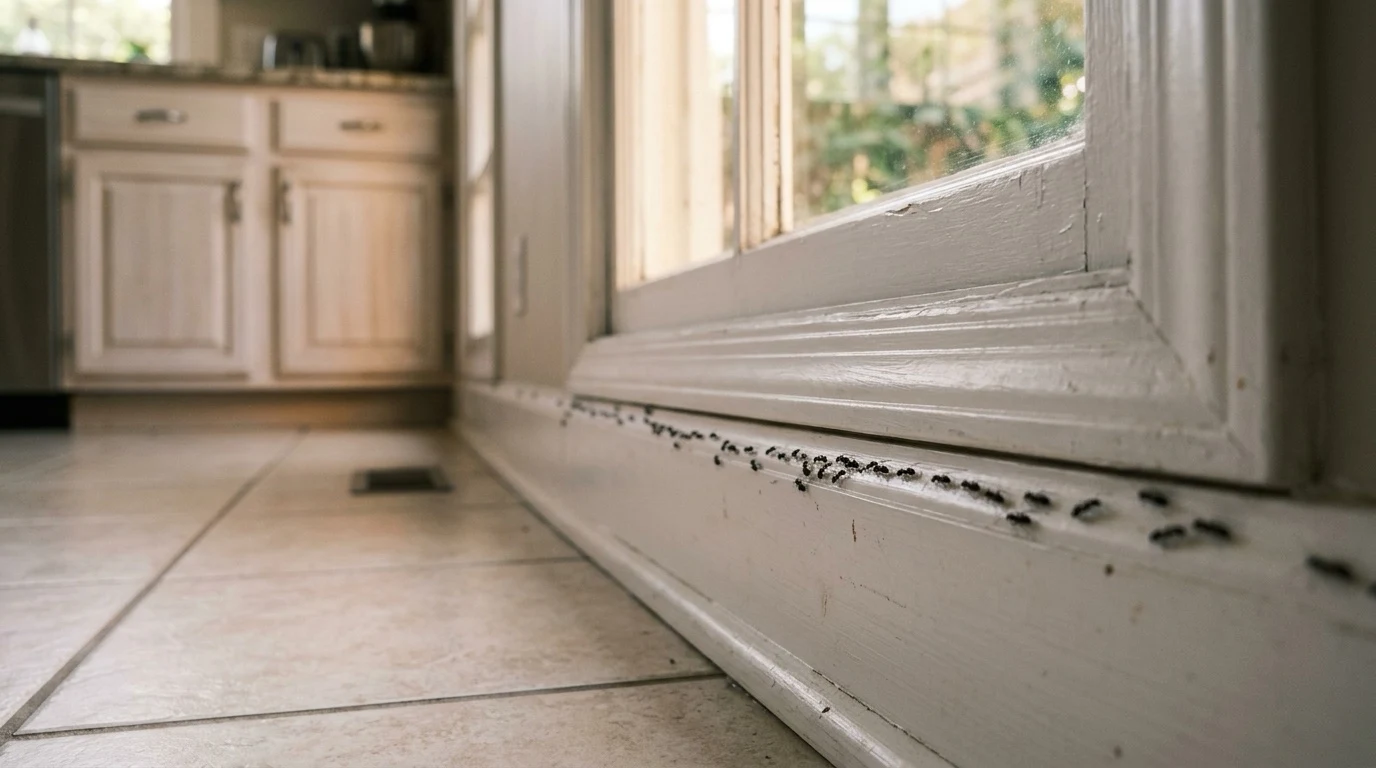
A trail of small dark ants running along the painted trim beneath a kitchen window, close to the joint where the trim meets the sill.
A trail is a route, not the colony. Follow it to the point where it disappears into trim or a wall gap, and you have found the way in. Illustrative photo.

1Which ant you are actually looking at

Almost every ant trail in a Monterey Bay kitchen leads back to one species. The Argentine ant, Linepithema humile, is about 1/8 inch long, dull brown, and carries a single node at the waist. The UC Riverside Center for Invasive Species Research calls it the dominant nuisance ant in coastal and urban parts of California. The first state record of it dates to 1907.

Two other species turn up often enough to matter here. The odorous house ant is the same small size but darker, and it gives off a strong smell when crushed. The pavement ant is a little larger and builds the small mounds you see along sidewalk seams and foundation edges. Near oaks and older landscape trees, the velvety tree ant nests in dead limbs and stumps, and it bites when handled.

Getting the species right is not a formality. Where an ant nests decides where the work goes, and the species decides whether a bait gets taken at all. A pavement ant colony under a walkway and an odorous house ant nest in a wall void beside the water heater are two different jobs. An Argentine ant network spread across a whole block is a third.

  • Argentine ant (Linepithema humile): 1/8 inch, dull brown, one node at the waist, shallow mounds outdoors, long steady trails.
  • Odorous house ant (Tapinoma sessile): 1/8 inch, dark brown to shiny black, one node, strong odor when crushed. Nests in soil, in debris, or indoors in wall voids.
  • Pavement ant (Tetramorium caespitum): 3/16 inch, dark brown to black, two nodes at the waist, mounds in lawns and along sidewalks and foundations.
  • Velvety tree ant (Liometopum occidentale): 1/8 to 1/4 inch, brownish-black head, red thorax, velvety black abdomen. Nests in dead wood, tree limbs, stumps and logs.
  • Carpenter ant (Camponotus species): 1/4 to 1/2 inch, black or red and black, and it hollows out wood to nest in it. That is a wood-destroying insect, and our wood-destroying insects guide covers it instead of this one.

2How to tell ants from termite swarmers

Winged insects indoors are the one identification a homeowner should not guess at. Ants and termites lead to completely different work. Three checks settle it, and none of them need magnification. Trap one insect against a white sheet of paper and look at the antennae, the waist and the wings, in that order.

  • Antennae: winged and worker ants have elbowed antennae, with a clear bend partway along. Termite antennae are not elbowed.
  • Waist: the body of an ant is pinched in the middle, so it looks like it has a thin waist. A termite has a broad waist and reads as one straight body.
  • Wings: the hind wings of an ant are smaller than its front wings. On a termite, the front and hind wings are about the same size.

Argentine ants mate inside the nest and produce no outdoor swarm flight, which is unusual among ants. Winged insects pouring out of a wall or a window frame indoors point to a different species, or to termites. Have them identified before anything is treated.

3Why Central Coast homes get ants in spring and fall

Ant pressure here runs on a schedule. UC IPM records Argentine ant colonies founding new nests by budding through spring and summer. One or more queens walk out with a group of workers and start a nest nearby. In fall, separate colonies merge into larger colonies with many queens, and that combined colony carries through winter. The population outside your wall is at its largest right as the weather starts pushing it indoors.

On the coast side of Monterey and Santa Cruz counties we see the same two waves every year. Trails push indoors in early spring while colonies are expanding, then again in early fall as outdoor moisture drops off ahead of the first rains. In between, the water holding a colony against your slab is usually irrigation rather than weather. One leaking sprinkler head on the sunny side of a Salinas house can feed an entire kitchen trail.

UC IPM puts the mechanism plainly: ants move into buildings looking for food, water, warmth or shelter when conditions outside turn too wet or too dry. In a climate with a long dry summer and a wet winter, both triggers arrive on a calendar you can plan around. That is why UC recommends monitoring and treatment in late winter and early spring, while colonies are still small.

4The plants against your wall may be feeding the colony

Ants come indoors for water and crumbs, but most of their food is already outside. Argentine ants farm aphids, scale and other insects that give off honeydew, a sugary waste the ants collect straight from the insect. In return, the ants drive off the ladybugs, lacewings and parasitic wasps that would otherwise thin those herds out. UC Riverside measured that effect in citrus. Parasitism of California red scale ran two to five times lower where Argentine ants were present.

On a home lot the same arrangement is easy to spot. Look for a rose, a citrus tree or a coast live oak with sticky leaves and a steady column of ants running up the trunk. A plant like that within a few feet of the house gives a colony three things at once. It supplies food, it shades a nest site, and if a branch touches the siding it carries the ants over your foundation entirely.

5Where to look during a self-inspection

Treat the trail as a map rather than the problem. The ants you can see are foragers working a route between a nest and a food or water source. The useful work is following that route back to the point where it enters the building. Take a flashlight and start at the busiest end of the line.

  1. 1

    Follow the trail to the wall

    Trace the line in both directions until it disappears. Trails run along baseboards, counter edges, cabinet backs and window frames. They vanish at a gap around a pipe, an outlet, a vent, or a seam in the trim. Mark that spot. It is the entry point, and it is the most useful thing the inspection will give you.

  2. 2

    Check the water before the food

    Look under the kitchen sink, behind the dishwasher, at the toilet supply line and around the water heater. UC IPM notes that ants concentrate near sinks, cupboards and pipes because they are after moisture as much as crumbs. Odorous house ants that have settled indoors often nest in wall voids near pipes or a heater.

  3. 3

    Walk the same wall outside

    Look for shallow soil mounds at the foundation, mounds along the walkway, mulch piled against the stucco, plants touching the siding, and limbs or fence rails that bridge to the roof. Check the irrigation while you are out there. A wet spot at the foundation with a plant touching the wall above it is a complete route into the house.

Do not treat what you have not identified. This guide covers inspection, exclusion and sanitation only, and it gives no pesticide mixing or application steps on purpose. Any pesticide, including one bought at a hardware store, has to be used exactly as its label directs, because the label is the law. If you have found a nest inside a wall, or you are holding a winged insect you cannot name, stop there and have it identified first.

6Why sprays and home remedies do not end it

UC IPM is direct about perimeter spraying: it does not give permanent control. The spray kills the foraging ants and leaves the colony and its queens alive. You also lose the one thing the trail was good for. Once the line is gone, so is the map that would have led you to the entry point, and the replacement trail often comes in somewhere new.

Home remedies get repeated everywhere and hold up poorly. Vinegar, cinnamon and coffee grounds at entry points fill consumer articles. None of that appears in University of California or extension guidance, so we do not present it as control. The one wipe-down UC does support is plain soapy water along a trail. It removes the chemical trail the ants follow and breaks up recruitment to that route, but it reaches nothing in the nest.

  • Budding is normal for this ant. UC IPM records Argentine ant queens leaving with a group of workers to found nests nearby through spring and summer. Separate colonies then merge into larger multi-queen colonies in fall. That is why knocking out one visible nest rarely ends an infestation.
  • After a repellent spray, the workers you can see die and the colony behind the wall does not. UC IPM documents a further risk on its red imported fire ant pest note: spraying a nest directly can scatter the colony and make control harder. That note covers a different ant, so treat it as a reason for caution rather than a fact about Argentine ants.

Signs of ants in your home

Any one of these is worth a closer look. Two or more usually means an active problem rather than a stray insect.

  • A steady single-file trail running from a wall, baseboard or window frame to a food or water source. A heavy line can run thousands of ants long.
  • Ants clustered at the kitchen sink, the dishwasher, a shower or a toilet supply line. That usually means they are after water rather than crumbs.
  • Shallow soil mounds against the foundation, under pots and stepping stones, or small mounds along a sidewalk seam or driveway edge.
  • A strong, musty smell when a single ant is crushed, which points to the odorous house ant rather than the Argentine ant.
  • Ants moving along a fence rail, a tree limb or a utility line that touches the roof or siding, skipping the foundation entirely.
  • Sticky leaves and a column of ants on the trunk of a rose, a citrus tree or an oak within a few feet of the house.
  • Winged ants indoors in spring. Argentine ants mate inside the nest and do not fly, so winged insects inside point to another species or to termites.

What you can do yourself

These steps make a home less attractive to ants. None of them involve pesticides. That part is our job.

  1. 1

    Wipe the trail down with soapy water

    Plain soapy water on a cloth removes the chemical trail the ants have laid, so the next wave of foragers loses the route. Do the counter, the baseboard and the sill the line was using. Mark the entry point before you clean, or you will be guessing about it later.

  2. 2

    Seal the openings you found

    Caulk cracks and openings into the building, and close the gaps around pipes, electrical penetrations, vents and foundation edges. UC IPM lists this first among its prevention steps. It is also the one measure that keeps working after everybody stops paying attention.

  3. 3

    Fix the water

    Repair leaking faucets, pipes and sprinkler heads, and turn irrigation spray away from the foundation. Thirsty ants go where the water is. Through a dry Central Coast summer, the wettest ground on the lot is often the strip of landscaping against the house.

  4. 4

    Take the food off the menu

    Store food in clean, sealed containers rather than bags or open packaging, and clean up crumbs, grease and spills as they happen. Pet bowls, recycling and fruit left on the counter are the three that get missed. Ants recruit heavily to a reliable source, so an unreliable one is much less useful to them.

  5. 5

    Pull the landscape back from the wall

    Keep plants, grass and mulch at least a foot away from the foundation, and trim limbs and vegetation that touch the roof or siding. The gap makes foraging and nesting against the structure harder, and the trimming removes the bridges that let ants bypass the foundation. Clearing leaf litter and stacked debris takes away nest sites at the same time.

When to call a licensed pro

  • The trail comes back within days after you have cleaned, sealed and dried the area.
  • Ants are entering at several separate points, which usually means a colony network outside rather than one nest you can find.
  • You find ants nesting indoors, in a wall void or around water pipes and the water heater.
  • The ants are 1/4 to 1/2 inch long and black, or red and black. Those may be carpenter ants, which nest in wood, and our wood-destroying insects guide covers what to do next.
  • Winged insects appear indoors and you cannot tell an ant from a termite swarmer with confidence.

How we treat it

Species identification and trail inspection

The visit starts by identifying the species and following the trails back to entry points, nest sites and the moisture supporting them. Management differs by species and by colony structure, so this step shapes everything after it. It also separates a kitchen nuisance from a wood-destroying insect problem.

Slow-acting bait placement

A bait pairs an attractant with a slow-acting active ingredient. Foragers carry it home and pass it mouth to mouth to other workers, larvae and queens. That is how a bait reaches parts of a colony a surface spray never touches. UC IPM notes that bait control can take more than a week to show results, so heavy traffic at a station early on is expected.

Exclusion and conducive-condition correction

Sealing the openings the trails used, and correcting the moisture and harborage next to the structure, is the non-chemical half of the job. It is also the half that decides whether the next colony finds the same route open. On older coastal homes that usually means pipe penetrations, weep areas and irrigation more than anything else.

Monitoring on the seasonal cycle

UC IPM recommends monitoring and treating in late winter and early spring, while colonies are still small, rather than reacting after a heavy trail has formed. We plan follow-up visits around that window and around the fall shift, when separate colonies merge and pressure moves back toward the structure.

Ants: frequently asked questions

Why do I suddenly have ants in the house after it rains?

Rain pushes them indoors. UC guidance describes ants moving into buildings when outdoor conditions change, looking for food, water, warmth or shelter from wet ground. The same thing happens in reverse during a long dry stretch, when they come inside for water. It is not a sign of a dirty house. It means an open route exists between an outdoor colony and something indoors worth having.

Will spraying the ants I can see get rid of them?

No. UC IPM states that spraying around the foundation does not give permanent control. It kills the foraging ants and not the colony or the queens. The trail usually returns within days, sometimes at a new entry point. You have also erased the line that would have shown you where they were getting in.

Why do ants keep coming back after I seal the gap they were using?

Because an Argentine ant colony is spread across many connected nests instead of one. UC IPM records that they reproduce by budding, with queens and workers leaving to found nests nearby. Closing one opening removes a route, not the network outside. Sealing still earns its keep as part of a program that also removes water and food and treats the colony itself.

How do ant baits work, and how long do they take?

A bait combines an attractant with a slow-acting active ingredient, so workers live long enough to carry it home. UC IPM describes them passing it mouth to mouth to other workers, larvae and queens, which reaches the part of the colony a spray cannot. UC IPM also notes that bait control can take more than a week to show results. Heavy ant traffic at a bait in the first days is progress rather than failure.

Are the big black ants in my house carpenter ants?

Possibly, if they run 1/4 to 1/2 inch long and are black, or red and black. Carpenter ants (Camponotus species) hollow out wood to nest in it, which makes them a structural question rather than a kitchen one. Most household trails on the Central Coast are Argentine, odorous house or pavement ants, and none of those damage wood. If the ants are that large, read our wood-destroying insects guide and have the wood inspected.

Do vinegar, cinnamon or coffee grounds keep ants away?

No University of California or extension guidance backs those remedies, so we do not recommend them as control. What UC does support is plain soapy water wiped along a trail, which removes the scent trail the ants follow. Past that, the tested advice is unglamorous: seal the entry points, remove the water and food, and use baits that reach the colony.

Why is there a line of ants going up my citrus tree?

They are collecting honeydew, the sugary waste that aphids and scale insects give off, and they protect those insects from predators to keep the supply coming. UC Riverside found parasitism of California red scale in citrus ran two to five times lower where Argentine ants were present. A tree like that beside the house is a food source and, if it touches the siding, a bridge indoors.

When is the best time of year to get ahead of an ant problem?

Late winter and early spring. UC IPM recommends monitoring and treating then, while colonies are beginning to grow and populations are still small. On the Central Coast that lines up with the first wave of indoor activity, before colonies expand through spring and summer. Waiting until a heavy trail is crossing the kitchen means working against a much larger colony.

Sources

This guide is written and maintained by the licensed technicians at 101 Exterminators Inc. (SPCB Lic. #9119). Technical claims are checked against the references below.

Last updated .

The pests this guide covers

Photos, biology, danger level, and the species that actually turn up in Central Coast housing stock.

Services that address ants

Not sure what you are looking at?

A licensed technician can inspect the property and tell you what is there, how far it has gone, and what the options are. Serving Monterey, Santa Cruz, San Benito, and Santa Clara counties.