
1What silverfish are and why coastal homes get them
Silverfish (Lepisma saccharina) are wingless insects covered in fine silver scales, tapered toward the back like a carrot. Adults run about half an inch long, and some reach three-quarters of an inch. Two long antennae come off the head and three long filaments trail from the tail, which is the quickest way to separate them from anything else in the house. They feed at night and hide by day, so a sighting may come when one crosses a bathroom floor and slips under a vanity. UC IPM places them in damp, warm areas such as laundries. Check the room for persistent moisture instead of trying to judge it by a single temperature or humidity reading.
A coastal address does not tell you which room is damp. In a home in Monterey, Santa Cruz, Hollister, or the South Bay, inspect the reported room for a drip, condensation, poor ventilation, or damp stored materials. UC IPM also notes that silverfish and firebrats can enter new homes from drying outdoor areas or arrive with building materials. A sighting after construction therefore calls for inspection, not an automatic assumption that a pipe is leaking.
2How to tell a silverfish from a firebrat
Silverfish and firebrats look nearly identical at a glance. Both are wingless and scaled, both taper toward the back, and both carry two long antennae and three long filaments at the tail. Color is the first split: silverfish are shiny silver to pearl gray, and firebrats (Thermobia domestica) are mottled gray and brown.
The room can help with identification. Silverfish favor damp areas; firebrats favor much hotter, drier places such as a furnace room or attic. These are clues, not proof of a species. A clear photo or specimen helps when the finding will guide treatment.
- Silverfish: silver to pearl gray. Check damp bathrooms, laundry rooms, and storage.
- Firebrats: mottled gray and brown. Check hotter sites near heating equipment or in an attic.
3What silverfish damage looks like
Silverfish scrape paper and fabric with weak jaws. UC IPM shows grazed gray patches, missing print, and irregular holes that can spread from one area of a page. Dark discoloration may come from fungi associated with moisture, not from the insect alone. Save a photo and look for an insect, scales, or other evidence before blaming every damaged page on silverfish.
- Paper and books: notched edges, holes scattered through a stack, and ragged markings along the glued spine of a binding, where the paste is the attraction.
- Wallpaper and paste: grazed patches where the paper meets the wall, most often in a bathroom or a back hallway, since the paste is starch and the wall behind it holds moisture.
- Stored textiles: cotton, linen, and starched or sized fabrics in a box or a back closet, with cast skins, silver scales, and dark fecal specks left on the cloth and on the bottom of the carton.
Note: silverfish are a materials pest. UC IPM and NC State Extension both frame the problem as damage to paper, fabric, and stored food, and neither lists silverfish as a wood-destroying or disease-carrying insect. They do not tunnel structural framing the way termites do. The damage lands on what you have stored, and the moisture that drew them is worth a look on its own.
4Where to look during a self-inspection
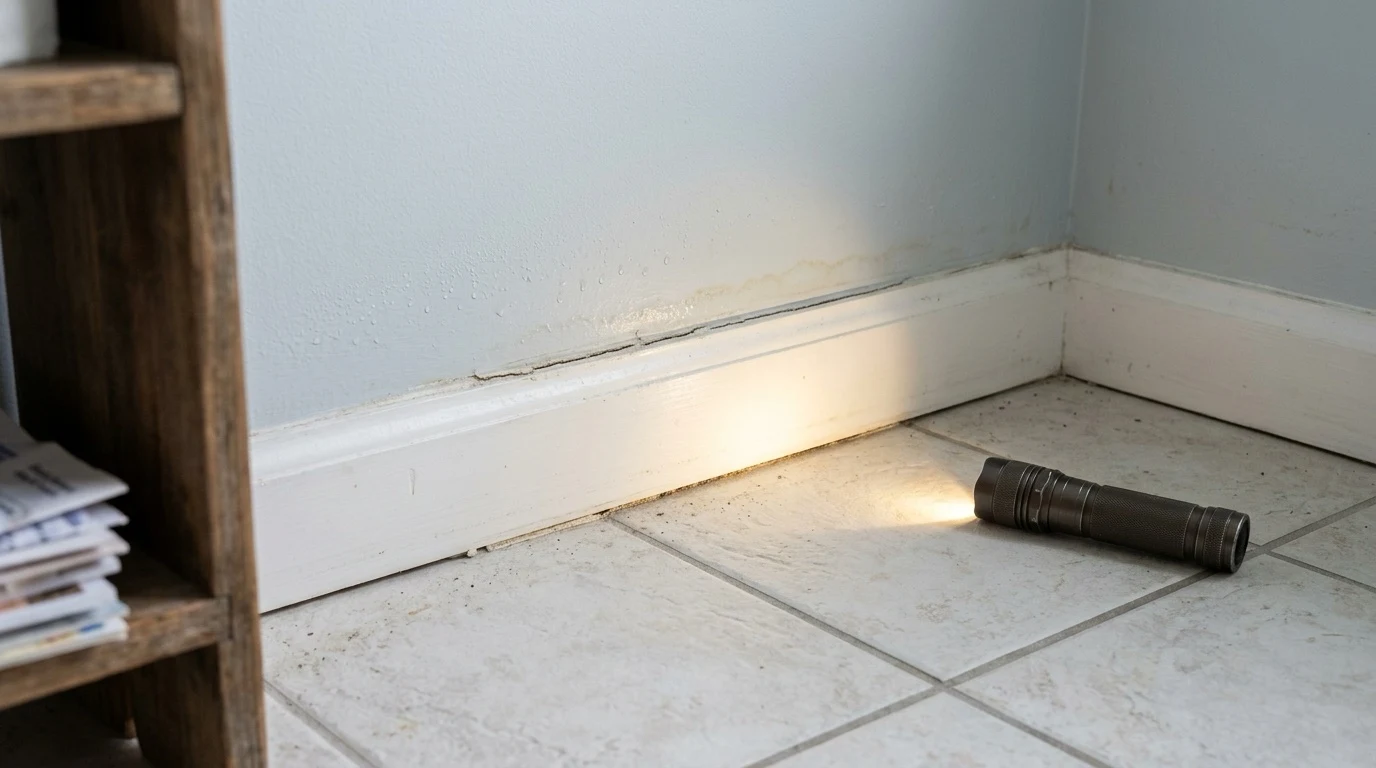
Silverfish are active at night and can travel away from their hiding place, so begin where one was seen and check nearby moisture and stored food or paper. A flashlight and a simple location log help you return to the same spots later.
- 1
Start in the bathroom and the laundry room
Check the shower stall, under the vanity, near the toilet base, and around accessible supply lines. Record insects, water, condensation, and gaps. A sighting does not prove the insects are breeding in that exact room.
- 2
Note crawl space moisture only if safely visible
If you can see into an existing access opening without entering, note standing water, wet soil, or damp framing. Do not open or enter a crawl space to pursue a silverfish sighting. Ask a qualified person to inspect a closed or unsafe area, especially where wiring, water, or rodent waste may be present.
- 3
Go through storage that has not moved in a year
Check books, boxed papers, and stored fabric for scales and feeding marks. Keep valuable items out of damp areas. Set a numbered sticky trap along an edge where activity is suspected and check it on a repeat schedule; the catch shows activity, not the full population size.
Do not put a pesticide into drains, electrical spaces, food storage, or an unlabeled location. Follow the product label for any consumer product, and ask a qualified provider to assess a persistent or widespread infestation.
5Why moisture control is the real fix
UC IPM treats moisture, food, and hiding places as the foundation of silverfish management. Focus on visible leaks, damp storage, and rooms that stay wet after use. Repair the source and improve ventilation where feasible. A dehumidifier may help in a closed damp room, but one reading does not tell you whether all hiding places have dried out.
Construction materials can also change indoor conditions. UC IPM notes that fresh concrete and unseasoned lumber provide moisture, while wallpaper paste provides food. If activity begins after work on a room, check the materials and ventilation as well as the plumbing.
- Ventilation: use bathroom and laundry ventilation that exhausts outdoors, and dry wet surfaces after use. A dehumidifier may help in a closed damp space. If a fan is not vented outdoors, have the ducting assessed rather than using it to push moisture into an attic.
- Crawl space: record visible water or damp soil from the access point and arrange an assessment of leaks, drainage, and any existing moisture barrier. The cause determines the repair; an insect treatment alone will not fix wet framing.
6What does not get rid of silverfish
Three approaches absorb most of the effort homeowners spend on silverfish, and none of them ends an infestation on its own.
- Foggers and bug bombs. UC IPM does not recommend them for silverfish or firebrats. They do not correct the dampness, food, or hiding places that let activity continue.
- Killing what you see. Silverfish hide by day and can survive for months without food. Remove a visible insect if you wish, but check for the damp storage or gaps that let activity continue.
- Waiting without checking. An isolated sighting may not need a pesticide, but fresh damage or repeated trap catches should lead to a closer inspection of moisture, storage, and possible hiding places.