
1Which wood-destroying insects are not termites
Termites get the attention, but three other groups work on the wood in a Central Coast house. Carpenter ants excavate wood to make room for a nest. Wood-boring beetles feed inside it as larvae and cut their way out as adults. Carpenter bees drill into it to raise their young. None of the three is a termite, and none of them is treated the way a termite is treated. Our termites guide covers those separately.
UC IPM names three carpenter ants common in California: Camponotus modoc, the western black carpenter ant, along with C. vicinus and C. clarithorax. Workers of the first two run 1/4 to 1/2 inch long, which makes them the largest ants most people ever see indoors. C. clarithorax workers are smaller, from 1/8 inch to under 5/16 inch. Carpenter ants do not eat wood. They cut a network of galleries and tunnels into it, and UC IPM notes that the nest most often starts where water or decay has already softened the wood. From there the galleries can expand into sound lumber and compromise structural integrity.
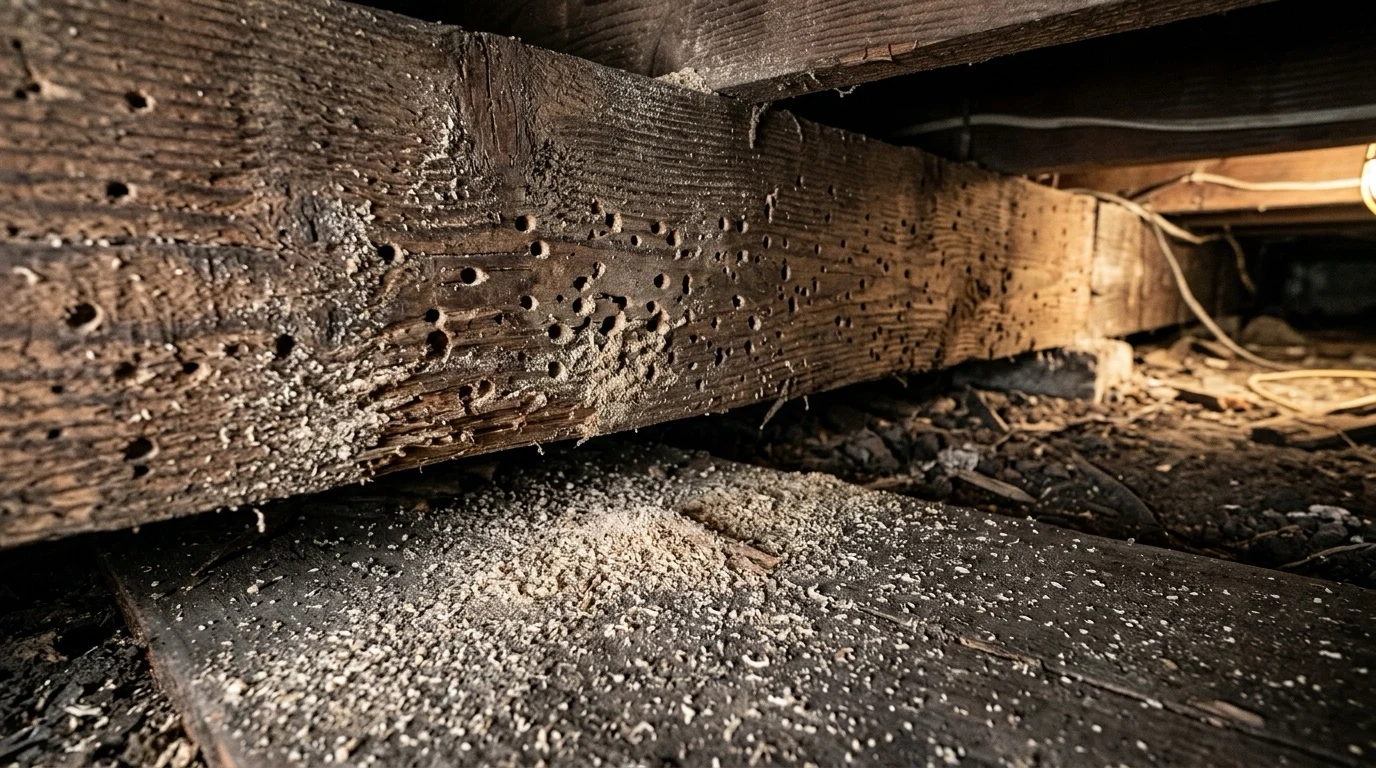
Wood-boring beetles are three families with three different habits. True powderpost beetles (family Bostrichidae, a group once classified as Lyctidae) attack wood with a moisture content as low as 8 percent. That low threshold covers hardwood flooring, trim, and furniture. Deathwatch beetles, also called anobiid beetles (family Anobiidae), prefer wood above 14 percent moisture, which is damp crawlspace framing. False powderpost beetles are the third group. Their generations are slow and uneven. UC IPM puts most of them at about a year, a powderpost beetle at three months to more than a year, and the black Polycaon at up to 20 years.
Carpenter bees are the largest of the three groups and the easiest to identify on sight. Females run 5/8 to 1 inch long and look like bumblebees with the fuzz missing, because the abdomen is bare and either shiny black or metallic blue. The valley carpenter bee is the one people ask about most here, since the male is golden brown and startles anyone who has only ever seen a black one. A female bores a tunnel about 1/2 inch across and 6 to 10 inches deep, then partitions it into chambers, each holding one egg and a supply of pollen. Unlike carpenter ants and the beetles, she works in sound wood, and UC IPM notes she sometimes uses decaying wood as well.
The three do not carry equal weight. Carpenter ant galleries in a wet sill plate or rim joist are a structural question, because UC IPM says outright that the galleries can compromise structural integrity. Anobiid beetles in damp framing matter for the same reason, and a generation of them can take up to two years, so the damage builds out of sight. Powderpost beetles in a floor board or a piece of trim are usually a finish problem rather than a framing problem. Carpenter bee damage is most often cosmetic, though the adults overwinter in old tunnels and nest again in the same wood, so it concentrates in one board year after year.
2Why Central Coast homes get them
Two conditions drive nearly every case we see across Monterey, Santa Cruz, and San Benito counties, and both of them are outside the wall rather than inside it. The first is moisture. Carpenter ants nest where wood has already been damaged by water or decay, and deathwatch beetles want wood above 14 percent moisture content. Coastal homes here sit under the marine layer for long stretches of the year. Older ones often pair that with a crawlspace that has weak ventilation and no working vapor barrier. Damp substructure framing is the exact wood both a carpenter ant colony and an anobiid beetle are looking for.
The second condition is bare wood, and that one belongs to carpenter bees. UC IPM notes that stained or unfinished wood is far more attractive to them than painted wood. On the Central Coast that means unpainted redwood fencing, exposed rafter tails and fascia, deck rails, garden structures, and the timber on farm outbuildings through the Salinas Valley. Paint that has weathered off over the years leaves the same open grain as wood that was never finished, so a board can turn into carpenter bee habitat without anyone changing anything.
Landscaping does the rest. UC IPM recommends keeping mulch around a building to a depth of 2 to 3 inches, which discourages carpenter ants from nesting in it. It also recommends eliminating earth-to-wood contact, because that contact starts the decay the ants follow. Every condition on this list is something you can check on your own property in an afternoon.
- Mulch piled deeper than 2 to 3 inches against the foundation or over a wood member.
- Structural wood in direct contact with soil, including posts, stair stringers, and siding.
- Roof leaks, gutter overflow, and plumbing leaks that keep framing damp for weeks.
- Bare or weathered exterior wood: fascia, rafter tails, fence rails, deck framing, and outbuilding timbers.
- Old carpenter bee tunnels left open after a previous season.
- Firewood, salvaged lumber, and untreated timber stored against the house.
Note: tree limbs and utility lines that touch the roof give carpenter ants a route in that never crosses the ground. If you find a trail on a fence or a branch running toward the house, follow it to the point where it reaches the structure before you look anywhere else.
3How to read exit holes and frass
Frass is the debris an insect pushes out of the wood, and its texture is the most reliable field clue a homeowner has. Hole size and shape narrow things down, but frass is what separates these three groups from each other and from termites. Collect a pinch on a sheet of white paper and look at it in good light.
- Carpenter ants: fibrous shavings closer to coarse sawdust than powder. UC IPM contrasts this fibrous frass directly with the six-sided pellets of drywood termites.
- True powderpost beetles: frass with the consistency of flour or talcum powder, packed tightly into the larval galleries and sometimes spilling out of the exit holes into small piles below. Their exit holes are uniform in size.
- Deathwatch (anobiid) beetles: very small pellets, slightly grittier than powderpost frass. Their exit holes vary in size rather than matching one another.
- False powderpost beetles: coarse frass about the texture of powdered borax soap, the grittiest of the three beetle types.
- Carpenter bees: a round entry hole about 1/2 inch across, usually on the underside of a board, with a tunnel 6 to 10 inches deep behind it.
- Drywood termites: hard pellets with six flattened sides, pushed out through kick-out holes less than 2 mm across. That is a termite finding, and our termites guide covers what follows from it.
Note: exit holes on their own prove only that a beetle once lived in that wood. Infested lumber gets built into houses, and an infestation can die out and leave its holes behind for decades. Fresh frass is what shows a live infestation, so clean the surface under the holes, mark the date, and check the same spot in a week or two.
4Where to look during a self-inspection
A flashlight, a flathead screwdriver, and half an hour cover most of a first pass. You are looking for evidence, not treating anything, so note the locations and leave the wood closed up. Work from the outside in.
- 1
Walk the exterior after dark
UC IPM notes that carpenter ants forage most actively after sunset, so a flashlight walk an hour after dark finds trails that are invisible at noon. Check the foundation line, fence rails, deck framing, and any tree limb that touches the roof. Follow a trail toward the building rather than away from it. The point where it disappears into siding, trim, or a soffit is the detail an inspector needs.
- 2
Check the wet places first
Look under the kitchen and bathroom, at the base of window and door frames, around the water heater, and anywhere a roof or gutter has overflowed. Carpenter ant nests begin in wood that water has already damaged. Press the screwdriver tip into any wood that looks stained or feels soft, and listen in a quiet room for the faint rustling that UC IPM describes coming from inside walls, floors, and woodwork.
- 3
Read the exposed framing in the crawlspace and attic
Unfinished framing is where beetle evidence shows first, because nothing covers it. Run the light along joists, subfloor, sheathing, and the tops of ledges where powder collects. Note two things about any holes you find: whether they match each other in size, and what the frass under them feels like between your fingers. Those two observations do most of the identification work.
- 4
Look at the underside of eaves, fascia, rails, and fences
Carpenter bees favor the protected undersides of boards, so the holes are easy to walk past. A round opening about 1/2 inch across, often with shavings on the ground beneath it, is a nest entrance. Old tunnels left open from previous seasons matter too, because adults overwinter in them and start again from there in spring.
Warning: crawlspaces and attics carry real hazards, including exposed wiring, standing water, and rodent droppings. If you cannot see the whole space from the access point, stay out and have it inspected. Do not apply any pesticide to what you find. Carpenter bees in particular are pollinators, and UC IPM does not treat insecticide as a first response to them.
5What does not work
Most do-it-yourself attempts on these three insects fail for one reason: the insect you can see is not the one doing the damage. The larvae are inside the wood, the colony is inside the wall, and the queen is somewhere a spray never reaches.
- Spraying the ants you see. UC IPM notes that only about 10 percent of a carpenter ant colony is out foraging at any one time. A contact spray on a trail reaches that tenth and leaves the nest, the brood, and the queen untouched. Slow-acting bait that workers carry back to the nest is the mechanism UC IPM describes instead.
- Treating the insects and leaving the leak. Carpenter ant nests start in water-damaged or decayed wood, and anobiid beetles need wood above 14 percent moisture. Correct the water and the condition goes away. Leave it and something moves back into the same board.
- Assuming kiln-dried lumber is permanently safe. UC IPM is explicit that kiln drying destroys an infestation already in the wood but does nothing to prevent the wood from being infested again later.
- Reading carpenter ant damage as termite damage. The frass is fibrous rather than pelleted, the galleries are cut rather than eaten, and the treatment is different in every respect. If the pellets you found have six flat sides, read our termites guide instead.
- Spraying carpenter bees on sight. UC IPM classifies them as beneficial pollinators and reserves insecticide for high infestations or genuine structural risk. Painting the wood and filling the old tunnels does more, and it holds.
- Filling bee tunnels in the middle of the season. Carpenter bees have one generation a year, and UC IPM ties any treatment to that cycle: early spring before nesting begins, or fall after all the adults have emerged.
6How these findings show up on a California WDO report
A wood-destroying organism inspection, the report that comes up in escrow, covers more than termites. Carpenter ants, carpenter bees, and wood-boring beetles are all recorded on it. The California Structural Pest Control Board notes that most lending institutions want a California home inspected for wood-destroying pests and organisms before they finance a loan, even though state law does not require an inspection before a sale. Companies that perform this work in California hold a Board license, and ours is SPCB Lic. #9119.
The history is available too. Reports and completion notices filed on a California property stay retrievable from the Board for the preceding two years, and pulling that record is often the fastest way to find out whether the same joist has been written up before. The report runs on the Board standard form, 43M-41, where a licensed inspector records what was visible in the areas they could reach under a fixed set of headings.
- Subterranean Termites, Drywood Termites, and Fungus or Dryrot each have their own heading on the form.
- Other Findings is where carpenter ants, carpenter bees, and wood-boring beetles are recorded, along with anything else the inspector identifies.
- Further Inspection covers areas that could not be reached, such as a blocked crawlspace or a finished wall.
Note: a beetle or carpenter ant finding does not read the way a termite finding does. It sits under Other Findings in the wording the inspector chose, which is what a buyer, an agent, and a lender then work from. Reading that description carefully is worth the five minutes it takes.
